

Commentary
Michael Young
{
  "authors": [
    "Michael Young"
  ],
  "type": "commentary",
  "blog": "Diwan",
  "centerAffiliationAll": "",
  "centers": [
    "Carnegie Endowment for International Peace",
    "Malcolm H. Kerr Carnegie Middle East Center"
  ],
  "englishNewsletterAll": "",
  "nonEnglishNewsletterAll": "",
  "primaryCenter": "Malcolm H. Kerr Carnegie Middle East Center",
  "programAffiliation": "",
  "regions": [
    "Israel",
    "Lebanon",
    "Levant",
    "United States"
  ]
}
Source: Getty
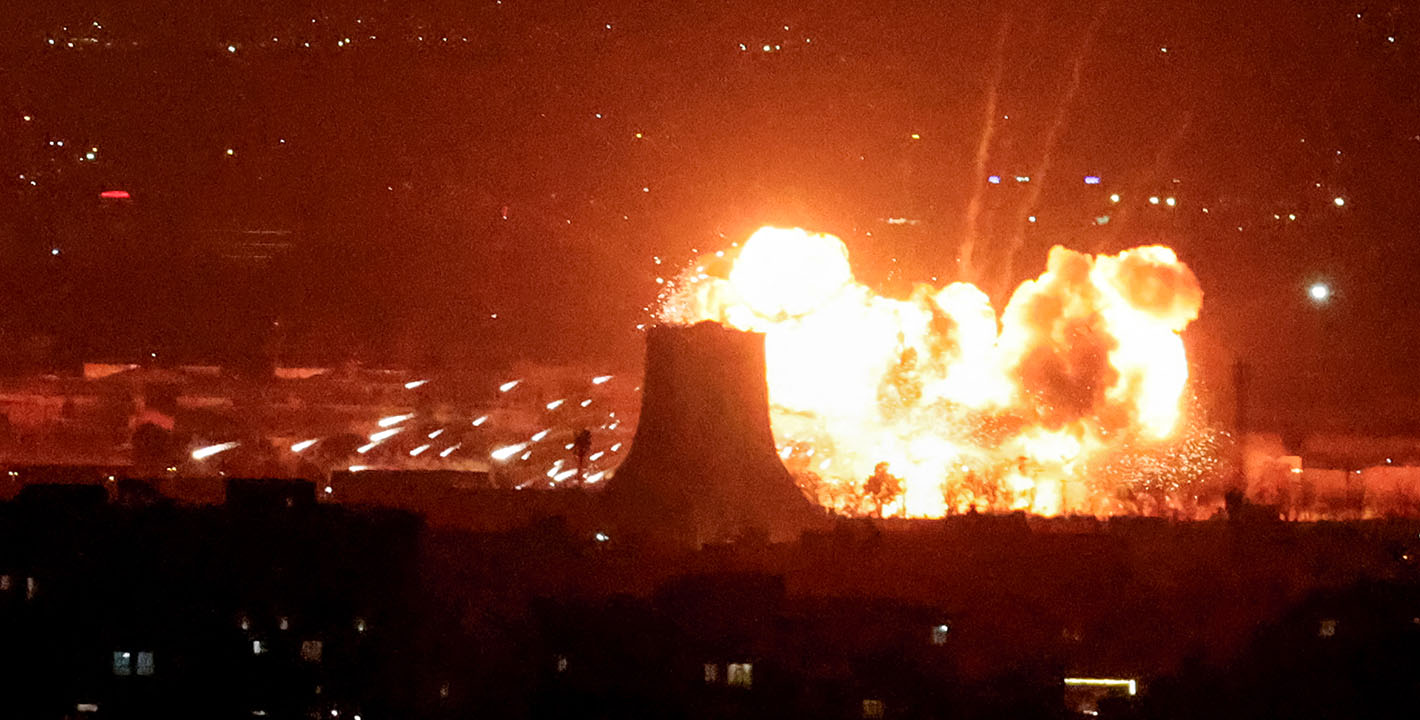
As negotiations with Iran and Lebanon continue, chaos is at the heart of the Netanyahu government’s calculations.
Israel is pursuing its annihilatory campaign in Lebanon under the guise of enhancing its security. However, it has long dawned upon most people in the Middle East (and not a few outside) that Israel’s concept of security, particularly under the extremist settler government of Benjamin Netanyahu, is anchored in maintaining permanent insecurity in surrounding countries and societies.
Israel has continued to apply this logic in Lebanon. Which is why it was interesting to see that in the latest round of negotiations between Lebanon and Israel on June 2–3, the sides agreed to a joint statement saying, “… Israel and Lebanon agreed to the implementation of a ceasefire. The ceasefire is contingent on a complete cessation of [Hezbollah] fire and the evacuation of all [Hezbollah] operatives from the South Litani Sector. The two sides agreed with the guidance of the United States to swiftly advance the creation of pilot zones in which the Lebanese Armed Forces will take exclusive control of the territory to the exclusion of all non-state actors.”
The plan has many potential pitfalls, but also represents the first practical effort to address the Lebanese government’s disarmament of Hezbollah. That said, the most significant question in it is how Israel will respond. While the latest conflict in Lebanon was provoked by Hezbollah’s decision to fire rockets at Israel on March 2, two things can be said about this. First, Hezbollah, since at least November 2024, has almost certainly been commanded by officers of Iran’s Islamic Revolutionary Guard Corps, something the Israelis knew well. Therefore, when they and the Americans killed Iran’s supreme leader, Ayatollah Ali Khamenei, they must have expected that Hezbollah would retaliate. Indeed, the Israelis likely welcomed it, because they had been looking for an excuse to restart the war and decisively cripple the party.
Second, in the sixteen months between the ceasefire of November 2024 and March 2026, Israel systematically refused to do anything to bolster the credibility of the Lebanese state in its confrontation with Hezbollah—a confrontation that escalated in August of last year when the government declared its intention to secure a monopoly over weapons. The U.S. envoy to Lebanon at the time, Tom Barrack, carried this decision to the Israelis to obtain concessions from them—for example, a partial withdrawal of forces occupying hills in southern Lebanon. He had declared before his departure, “I think the Lebanese government has done their part. They’ve taken the first step. Now what we need is Israel to comply with that equal handshake.”
However, Barrack received nothing in return. That wasn’t surprising, because he had failed to prepare for his visit, whether in Washington or Israel. Nor did he address rising pro-Israel voices at home, who began targeting him because he had stated that Lebanon’s Shiite community needed to “save face” in the process of Hezbollah’s disarmament, and mentioned Iran’s stakes in Lebanon. He also underlined that the Lebanese army was in no position to disarm Hezbollah by force. Those moments of lucidity only highlighted his diplomatic shortcomings, since the truth invariably hinders successful diplomacy. Barrack further aggravated his case when, sensing the rising hostility in Washington, he began criticizing the Lebanese side.
By neutralizing Barrack over Lebanon, by playing a central role in persuading the Trump administration to attack Iran in 2025 and 2026, Israel confirmed it was far more comfortable managing disorder than finding solutions to its challenges. My colleague Nathan J. Brown succinctly described Israel’s strategy in this way: “What has emerged is a new approach to Israeli security, one of dominance without settlement, degradation without reconstruction, territorial denial without a political horizon, and war not as a bridge to an arrangement but as the arrangement itself.”
That is precisely why the latest U.S. proposal to establish “pilot zones” is raising such doubts, and why one must read the fine print closely. The conditionalities it imposes—that the “ceasefire is contingent on a complete cessation of [Hezbollah] fire and the evacuation of all [Hezbollah] operatives from the South Litani Sector”—effectively hands veto power to both Israel and Iran, neither of which wants the Lebanese government to assert a monopoly over weapons. Iran is not willing to see Hezbollah disarmed, while Israel does not trust the Lebanese government to maintain security in the south, therefore would prefer to pursue a unilateral path to security.
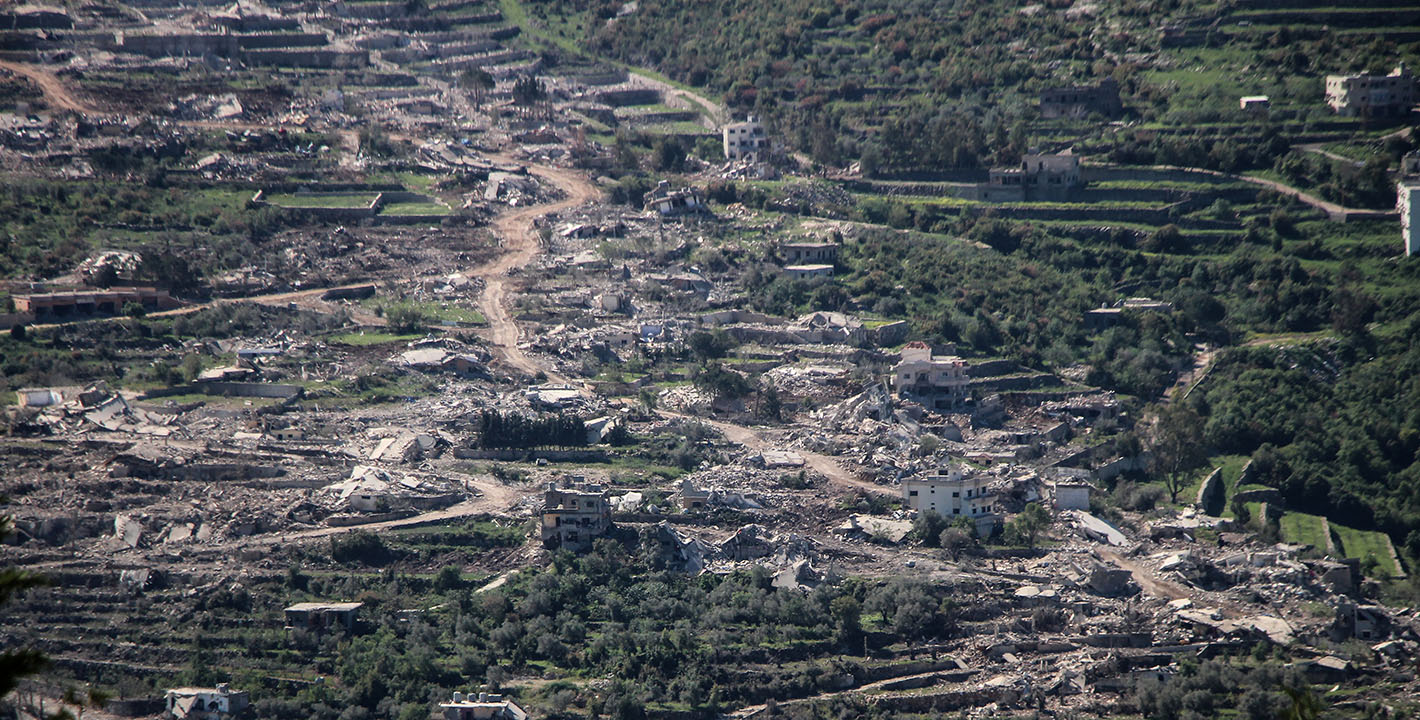
The Israelis like to repeat they are establishing a buffer zone in the south to protect their northern communities. However, there is a lot to suggest that Israeli thinking goes well beyond that. The systematic razing to the ground of dozens of mainly Shiite southern villages suggests much more a plan of sectarian demographic reengineering—or to put it more bluntly, ethnic cleansing—than a security plan. Moreover, by pushing the Shiite population of the south northward, toward Sidon and Beirut, doing the same in the southern Beqaa Valley, and by trying to empty the southern suburbs of Beirut of hundreds of thousands of its mainly Shiite inhabitants and pushing them into non-Shiite areas, Israel is really aiming to exacerbate sectarian tensions in Lebanon.
This reminds me of what one of Israel’s American myrmidons had written while serving as a researcher in a notable pro-Israel think tank in Washington almost a decade ago: “Lebanon’s stability, insofar as it means the stability of the Iranian order and forward missile base there, is not, in fact, a U.S. interest.” Aside from the fact that the author equated the interests of the United States with those of Israel—a revealing sleight of hand—it reflected a much more hardline approach to Lebanon circulating at the time, and that now seems to have been adopted by the Netanyahu government.
Open-ended instability, in Lebanon, Syria, Gaza, and the West Bank, is simply one dimension of Israel’s broader struggle with Iran—and soon Türkiye—at the regional level. Israeli hubris has been largely facilitated by the United States, in the mistaken belief that as the Americans disengage from the region, it is in their interest to leave behind a dominant pro-American power in place to keep the region in line. That is the real thinking behind the so-called Abraham Accords, viewed as the political spine of this imagined U.S. order, which is to be fused with an Israeli military spine.
But what is emerging is something very different, and interesting, albeit whose dimensions and fortitude still remain unclear: a coalition of states, including Saudi Arabia, Türkiye, Pakistan, Egypt, and Qatar, which is trying to stabilize the region as the Trump administration comes to grips with the disastrous repercussions of its military campaign, and Israel’s, against Iran. These states have come together to serve a dual purpose: to contain the destabilizing destructiveness of Israeli policies, which has largely been embraced by the Trump administration; and to establish a counterweight to any power—Israel, but also Iran—that aspires to regional hegemony. We’re witnessing realpolitik 101, in which the enemy today may be an ally tomorrow against the ally of today who may try to assert its supremacy tomorrow.
This coalition of countries is also unified around the idea that Israel cannot expect normalization with the Arab world unless it accepts progress toward a Palestinian state. In this regard, it represents a direct challenge to the U.S. approach centered on the Abraham Accords, which aim to circumvent the Palestinians. Palestine is a house of many betrayals, but in this case the coalition’s message is tied to a more fundamental objective—to push back against Israel’s preference for advancing its agenda of rearranging the region to its advantage behind a barrier of chaos. This, in turn, will imply a deep rift among Washington’s purported allies in the Middle East, further eroding what remains of the American-sponsored regional order.
Facing such a stark alignment of contending forces, how will the United States—the Trump administration or a successor—react? It has often seemed that Israel can do no wrong in Washington, where it retains powerful allies; but would that be true if Israel’s actions were to undermine what remains of Pax Americana in the region? The first step in that direction was to push the United States into a war with Iran, leading to a fiasco of monumental proportions, which even analysts sympathetic to the president (who also happen to be very close to Israel) now acknowledge.
If Israel is seen increasingly by the United States as a strategic liability, and we may be heading in that direction, the Americans may subtly change course. They may return to an attitude of benign neglect, not so very different than the one that followed their disastrous venture in Lebanon in 1982–1984, itself a consequence of Israel’s invasion of the country. In that case, Israel could well be compelled to recalculate.

Editor, Diwan, Senior Editor, Malcolm H. Kerr Carnegie Middle East Center
Michael Young is the editor of Diwan and a senior editor at the Malcolm H. Kerr Carnegie Middle East Center.
Recent Work
Michael Young
Michael Young
Carnegie does not take institutional positions on public policy issues; the views represented herein are those of the author(s) and do not necessarily reflect the views of Carnegie, its staff, or its trustees.
Trade statistics show why Amman has more reason than Damascus to welcome the improvement in bilateral commerce.

Armenak Tokmajyan
Adversaries are to be degraded so deeply, that reconstitution becomes difficult or impossible.

Nathan J. Brown

Israel is encroaching on the country’s territory, while the Lebanese look askance at one another.

Issam Kayssi
The party’s domestic and regional roles have changed, so Lebanon should devise a disarmament strategy that encompasses this.
Michael Young
In an interview, Marc Lynch discusses his new book decrying the post-1990 U.S.-dominated order in the Middle East.
Michael Young